There are countless ways for a mystic to seek enlightenment, and compassion stands as a vital component along every path. Whether through meditation, silence, devotion, study, ecstatic surrender, or other practices, the pursuit of lasting compassion comes only through understanding, love, and acceptance.
Many mystics recognize this truth, which is why enlightenment is often described not as an instant achievement, but as an ongoing process—your great work!
True compassion, beyond fleeting sentimentality, develops gradually and quietly. When your heart no longer feels the need to defend against the world and its happenings, you are moving in the right direction.
Compassion softens the heart, shifting focus toward a unified love and away from fear, misunderstanding, pain, or suffering.
To embody compassion is to witness another’s pain without turning away, to replace fear with love, judgement with curiosity and empathy, and to let the boundaries of self dissolve for the sake of all living beings as one.
Oneness, love, and compassion are essential for true enlightenment and for achieving Peace Profound.
Steps Toward Compassion
How do we embark on this journey?
First, acknowledge who you are and where you stand.
Second, accept the work and service that lies ahead in your life.
Third, open the door and begin the journey each day, rather than remaining in thought alone.
The Path to Illumination
Compassion truly is a path to illumination. The process of learning and practicing genuine compassion is a lifelong journey.
This journey is shaped by experience; it involves learning along the way, including the inevitable ups and downs of life.
Love, understanding, and oneness are the foundational keys.
The Nature of Illumination
Illumination is not a single, grand moment of arrival. Instead, it grows from daily experiences, service, trials, and challenges, alongside compassion.
Practical Actions to Foster Compassion
Pause irritation and listen more deeply and curiously.
Assess situations without judgement.
Offer help without seeking praise or acknowledgment.
Recognize the pain within another’s suffering or anger.
Understand that everyone is experiencing what they need to experience.
Live each moment, adjusting as needed, without judging yourself or others.
Be conscious in thought, word, and action, and continue moving forward.
Principles and Practices of Compassion
Certain Rosicrucian and Hermetic principles support the journey toward illumination and compassion:
All is One—We are all connected.
As Above, So Below—As within is as without.
Universal or Divine Cosmic Higher Love.
Practices that nurture compassion include kindness, understanding, and the pursuit of Peace Profound. For all mystics, reflection, meditation, adaptation, and service are essential practices.
Compassion as a Mode of Perception
Compassion is more than a feeling; it is a mode of perception. It involves shifting from seeing only the surface—such as behavior, flaws, or roles—to recognizing the underlying fear, longing, suffering, and basic humanity.
This perceptual shift is the path to illumination, as it dissolves the illusory boundaries between “Self” and “Others.”
As this shift unfolds, “your” problems become “our” problems, and “they” become “us.”
This transformation does not happen overnight; it is gradual, fluctuating according to life’s circumstances.
The journey of compassion and oneness reveals the shared spark of consciousness in all beings. As perception shifts, the ego releases control, the heart opens, and enlightenment emerges.
Compassion clears the inner mirror, fostering self-understanding and peace.
Beginning the Journey
Start with yourself, focusing on your personal journey while embracing the shared journey of humanity. Here are some practical tips:
Ask yourself what you need to learn or experience.
Embrace the journey, including the unexpected.
Be present; assess and adjust daily.
Take one moment and one day at a time.
Release anger, jealousy, bitterness, hatred, and fear.
Recognize what you can control.
Manage and mitigate challenges, knowing some cannot be eliminated.
Enjoy each moment, even if it’s difficult.
Focus on happiness that is not dependent on circumstance or time.
Peace Profound
The concept of Peace Profound is central to achieving lasting inner peace and compassion. H. Spencer Lewis described it as “The harmony of man’s accord with the Cosmic.”
Peace Profound is a state of mind in which you acknowledge and care about what is happening, but do not become overwhelmed by external situations. Instead, you consciously, philosophically, and compassionately evaluate your thoughts and actions.
Embracing the Shared Journey
Consider the possibility that everyone is doing what they are meant to do. Often, we try to fix others or situations from our personal perspective, but one key Rosicrucian principle is to begin with yourself and those closest to you. If everyone did this, the world would improve for all.
So, begin with your own thoughts, words, and actions. Stop judging where others should be or what they should be doing. Accept the unexpected, assess, and adjust as needed.
Compassion is about understanding, not necessarily agreeing. You can have compassion for someone or a situation, even when you disagree.
Everyone brings something unique to our shared journey. Pay attention!
The Challenge of Judgement
Judgement is our greatest accuser. In various traditions, the devil or demon represents this force. Self-judgement is a major obstacle to healthy personal growth, while judgement of others blocks true compassion.
Try an exercise: for one day, honestly refrain from judging others and count how often you catch yourself doing so in thought.
Be present, assess, and adjust—remember, you create your reality through thought and action. Forgive yourself, forgive others, and move forward with love.
Compassion in Mystical Traditions
Across mystical traditions, compassion is seen as dissolving self-centeredness and expressing higher love:
Buddhism: Compassion keeps the enlightened being engaged with the world to help others awaken.
Christianity: Compassion is agape, a divine love that shares in suffering and redeems humanity.
Sufism: Compassion arises from a heart polished by remembrance, reflecting divine qualities.
Taoism: Compassion is one of the “Three Treasures,” aligning human life with the Tao’s harmony.
In each tradition, compassion is both the path and the result of illumination.
Stoicism and Compassion
Ancient Greek and Roman Stoicism offers valuable insights for practicing compassion. Stoicism encourages living virtuously, cultivating wisdom, justice, courage, and moderation. It teaches acceptance of what we cannot control and focuses on thoughts, actions, and character.
Cultivate wisdom, justice, courage, and moderation.
Live in accordance with nature.
Focus on the present.
Embrace fate and accept what happens.
Develop a rational, resilient mindset.
Control your reactions.
Apply objective understanding.
See obstacles as opportunities.
Compassion aligns with Stoic ideals of interconnectedness, social duty, empathy, and self-transformation. Practicing Stoicism does not mean indifference; rather, it means accepting reality, helping where you can, and striving to better yourself.
Dissolving the Self: The Alchemical Journey
Mystically, extending true compassion shifts the sense of self toward unity, making separation feel like an illusion. All suffering becomes part of your awareness, ideally without overwhelming you.
This leads to personal alchemical transformation, where you accept and reflect on trauma, suffering, pain, or awakening revelations—experiences that may unsettle your world.
This process, known as calcination and dissolution, involves combining the ashes of previous experiences with the water of your heart and emotions. Through this reflection, you move forward with compassion for yourself and others.
Immersing yourself in the unconscious or rejected parts of your heart or mind can be dark, but it is also an opportunity to transform fear into understanding, anger into clarity, pain into connection, and ignorance into wisdom.
Rather than avoiding suffering, compassion allows for reflection, forgiveness, release, adjustment, acceptance, and presence with others and yourself. See these experiences as opportunities, not punishments or karma.
The Seven Alchemical Processes of Life
Everyone undergoes the seven alchemical processes of life daily. Understanding these natural phases inspires compassion for the journeys that others—and you—may be undertaking.
Compassion is a two-way street; it is important to have compassion for yourself as well as others, embracing the processes you may need to experience or learn from.
Summary of the Seven Processes of Transformation
Calcination: Extreme events, trauma, or awakening of self-consciousness; destruction of ego and defense mechanisms; opportunity for release and growth.
Dissolution: Combining the ashes of previous experiences with the heart’s emotions; immersion in the unconscious or rejected parts of the self.
Separation: Rediscovering dreams and visions; creating a new path forward.
Conjunction: Empowering your true self through harmony of mind and heart.
Fermentation: Releasing fears and limitations; embracing new experiences with inner guidance and surrender.
Distillation: Purifying the self; raising consciousness and harmonizing transformation.
Coagulation: Achieving new confidence and unity with all; mastery of self and cosmic consciousness.
These processes are ongoing; you may revisit stages to learn or experience something previously missed or not yet ready for.
The Journey of the Wanderer: Symbolism and Metaphor
The wanderer’s journey to enlightenment is depicted in symbols such as the Fool tarot key and the loyal dog, representing consciousness and reason—much like Dorothy and Toto in the Land of Oz. In these stories, they to go through the seven alchemical processes. This can also be depicted in the Tarot via Le Tableau where when aligned in seven columns, they correspond to the seven alchemical processes of life’s journey summarized:
Calcination or release from bondage
Dissolution or awakening of new inner potential
Separation or revelation to move forward
Conjunction or acceptance of the inner and outer Self
Fermentation or regeneration of purpose
Distillation or realization of higher purpose
Coagulation or mastery of Self and oneness with all
Opportunities for compassion, enlightenment, experience, lessons, or initiation may arise unexpectedly. Keep your mind and heart open. Like the Fool or Dorothy, do not let fear keep you from your path.
Dorothy’s compassion for her companions helped her discover her inner strengths and the magic within herself.
You do not need a wizard to tell you that you possess a heart for compassion; simply embrace the journey and continue along the path of enlightenment and compassion each day at your own pace.
Embracing Oneness and Practicing Compassion
Embrace the experience of oneness. Practice understanding, acceptance, and love. Engage in good, kind, caring, and nurturing behavior that aligns with natural law and avoids judgement. By doing so, you will naturally walk the path of enlightenment and compassion, becoming a healthy, integral part of the all-oneness.
Remember, “there is no place like home,” and in this journey, home is your Master Within.
The Mystical Journey in The Wizard of Oz
The Wizard of Oz is a metaphorical, Hermetic, Alchemical, and initiatic journey, filled with elements, alchemical processes, esoteric symbolism, compassion, understanding, forgiveness, acceptance, and awakening to enlightenment.
Dorothy represents the soul’s unfolding, with compassion for all beings—her companions representing the divine essence within the mystical elements of fire, water, air, and earth, which exist within each of us. Toto symbolizes the totality or “all.”
The Tin Man represents the work of finding the heart of compassion, already present within.
You already have a heart for compassion; embrace the journey and move forward each day.
The book discusses the teachings of the Rosicrucian Order, focusing on spiritual concepts, healing, and the nature of existence. Messages from Celestial Sanctum The text is a collection of messages from the Celestial Sanctum, translated by Elizabeth Quan. It emphasizes the importance of visualization and cosmic attunement for spiritual growth. The author, Raymond Bernard, served as a Supreme Legate of the Rosicrucian Order AMORC for Europe.
Celestial Sanctum
Celestial Sanctum is visualized as a cathedral, representing a place of spiritual connection and enlightenment. Members are encouraged to visualize their own sanctum to facilitate personal spiritual experiences. The sanctum serves as a focal point for receiving cosmic light and guidance.
Spiritual Healing
Healing is presented as a natural ability that can be cultivated through spiritual practices and positive thought. The text emphasizes the importance of intention and love in the healing process. It discusses the relationship between physical health and spiritual well-being.
Law of Compensation or Karma
The law of karma is described as a universal principle governing actions and their consequences. It emphasizes personal responsibility for one’s actions and the impact on future experiences. The text explains that karma can be influenced by positive thoughts and actions.
Successive Lives
The concept of reincarnation is explored, stating that soul-characteristic personalities evolve through multiple lives. Each life is an opportunity for growth and learning, with experiences shaping the soul’s journey. The text asserts that once a soul reaches the human stage, it cannot regress to lower forms of existence.
Modern Mystic
The modern mystic is portrayed as someone who integrates spiritual practices into daily life while remaining engaged with the world. The text highlights the importance of balance between spiritual pursuits and material existence. It encourages individuals to embrace their unique paths while contributing positively to society.
Initiation in Celestial Sanctum
The initiation ceremony is described as a profound experience that elevates the initiate’s consciousness. It symbolizes the awakening of the soul and the attainment of greater spiritual understanding. The text emphasizes the importance of humility and service in the life of an initiate.
Conclusion
The document concludes by urging readers to seek knowledge and understanding through the teachings of the Rosicrucian Order. It encourages regular visits to the Celestial Sanctum for spiritual growth and enlightenment. The overarching message is one of unity, love, and the pursuit of higher consciousness.
PENTACLE: 108 Degrees Every Cell in our bodies is a Platonic Solid crystal form. Every Protein in our bodies is Pent shaped, and therefore based on Phi proportions.
The more we zoom in and construct the Pentacle within the Pentacle, a process that can go forever, the more the Phi ratio is evident.
This means that our human constitution is based on Self-Similarity, an expression of Fractality evident in the Spirit molecule that knows only Phi and has no boundaries.
The currently immense fascination with 108, how it is the measure of the external angles of the pentacle (108 degrees), permeates our entire physical matrix.
Discovering one’s purpose in life is a journey that many individuals embark upon at some point. This quest for meaning and direction has a profound influence on personal growth, happiness, and overall well-being. Finding a purpose can bring clarity to decision-making, boost motivation, and provide a sense of fulfillment that enhances every aspect of life.
The path to uncovering life’s purpose involves various techniques and approaches. These include looking back on past experiences, exploring passions and interests, and evaluating personal values and beliefs. Additionally, the process often involves identifying strengths and skills, thinking about one’s impact on others, and trying out different paths. Practices like mindfulness and meditation can also play a crucial role in this journey of self-discovery, helping individuals connect with their inner selves and the wider community.
Understanding the Concept of Life Purpose
Life purpose is a concept that has captivated human curiosity for centuries. It encompasses the central motivating aims of an individual’s life—the reasons they get up in the morning [1] https://www.takingcharge.csh.umn.edu/what-life-purpose. Purpose can guide life decisions, influence behavior, shape goals, offer a sense of direction, and create meaning [1] https://www.takingcharge.csh.umn.edu/what-life-purpose. It’s a fundamental aspect of human existence that has a profound impact on personal growth, happiness, and overall well-being.
Defining Life Purpose
William Damon, a Stanford University professor and author of “The Path to Purpose,” defines purpose as “a stable and generalized intention to accomplish something that is at the same time meaningful to the self and consequential for the world beyond self” [2] https://greggvanourek.com/most-common-myths-about-purpose/. This definition highlights the dual nature of purpose—it’s both personally fulfilling and contributes to something larger than oneself.
Purpose is adaptive in an evolutionary sense, helping both individuals and the species to survive [3] https://greatergood.berkeley.edu/article/item/how_to_find_your_purpose_in_life. It grows from our connection to others, which is why a crisis of purpose is often a symptom of isolation [3] https://greatergood.berkeley.edu/article/item/how_to_find_your_purpose_in_life. For some, purpose is connected to vocation—meaningful, satisfying work. For others, it lies in their responsibilities to family or friends. Some find meaning through spirituality or religious beliefs [1] https://www.takingcharge.csh.umn.edu/what-life-purpose.
Common Misconceptions
Several misconceptions about life purpose can hinder one’s journey of self-discovery:
Purpose is the same as passion: While connected, purpose (why we’re here) and passion (a compelling feeling or emotion) are not equivalent [2] https://greggvanourek.com/most-common-myths-about-purpose/.
Purpose must be completely original: The key is authenticity, not originality [2] https://greggvanourek.com/most-common-myths-about-purpose/.
Purpose is a luxury for the privileged: In reality, purpose is universally available and accessible to all [2] https://greggvanourek.com/most-common-myths-about-purpose/.
Purpose should come as a revelation: The notion that purpose will come fully formed and crystal clear is unrealistic. It often unfolds messily over time [2] https://greggvanourek.com/most-common-myths-about-purpose/.
Purpose is all about personal needs and wants: True purpose always comes back to others and to something larger than ourselves [2] https://greggvanourek.com/most-common-myths-about-purpose/.
Purpose is fixed and unchanging: For many, purpose evolves through different life chapters and seasons [2] https://greggvanourek.com/most-common-myths-about-purpose/.
Benefits of Having a Clear Purpose
Having a clear sense of purpose has numerous benefits for mental and physical well-being:
Stress Management: Purpose helps stave off stress and can aid in channeling challenges toward learning and growth [4] https://greatergood.berkeley.edu/article/item/how_strong_is_your_sense_of_purpose_in_life.
Improved Health: People with greater purpose make healthier life choices, engage in more preventative behaviors, and tend to have better health and longevity [4] https://greatergood.berkeley.edu/article/item/how_strong_is_your_sense_of_purpose_in_life.
Cognitive Benefits: Older adults who report more purpose in life experience less functional decline, less cognitive and memory impairment, and a lower risk of Alzheimer’s disease [4] https://greatergood.berkeley.edu/article/item/how_strong_is_your_sense_of_purpose_in_life.
Increased Fulfillment: Living a life on purpose is filled with meaning. People on purpose realize they are making a difference in the world simply by being in the world [5] https://personalgrowthinformation.com/top-ten-benefits-to-knowing-and-living-your-life-purpose/.
Enhanced Integrity: A life on purpose is a life of ultimate integrity—whole and complete. People who know their purpose and live it know who they are and why they are here [5] https://personalgrowthinformation.com/top-ten-benefits-to-knowing-and-living-your-life-purpose/.
Increased Synchronicity: Many people report a surprising increase in synchronicity and serendipity in their lives as they clarify and live true to their purpose [5] https://personalgrowthinformation.com/top-ten-benefits-to-knowing-and-living-your-life-purpose/.
Understanding the concept of life purpose is a journey of self-discovery that requires reflection, exploration, and often, trial and error. It’s a deeply personal process that can evolve over time, shaped by experiences, relationships, and personal growth. By grasping the true nature of purpose and dispelling common misconceptions, individuals can embark on a meaningful quest to uncover their unique reason for being, ultimately leading to a more fulfilling and impactful life.
Reflecting on Your Past Experiences
Reflecting on past experiences is a crucial step in discovering one’s purpose in life. This process involves examining significant moments, recognizing patterns, and learning from both challenges and successes. By delving into personal history, individuals can gain valuable insights that shape their future path and contribute to a more meaningful existence.
Identifying Meaningful Moments
Life is filled with defining moments that have the potential to shape an individual’s trajectory. These experiences often serve as turning points, offering clarity and direction. For instance, one engineering student discovered the importance of continuous learning during their final year, which ignited their curiosity and set the stage for future endeavors [6] https://greatergood.berkeley.edu/article/item/seven_ways_to_find_your_purpose_in_life. Similarly, others have found their defining moments in unexpected places, such as realizing they were not suited for working under others, leading them to pursue entrepreneurship [7] https://www.betterup.com/blog/finding-purpose.
To identify these meaningful moments, individuals can ask themselves:
What experiences have had a lasting impact on their life?
Which decisions or events led to significant changes in their path?
What moments have they felt most alive or purposeful?
Recognizing Patterns and Themes
As people reflect on their past, they often notice recurring themes or patterns in their experiences. These patterns can provide valuable insights into one’s strengths, values, and potential areas for growth. For some, this might manifest as a consistent ability to see connections or predict outcomes that others miss [8] https://medium.com/@anferneeck/finding-your-purpose-a-journey-of-self-discovery-8221054cf098. Others might notice recurring challenges in relationships or work environments [9] https://www.linkedin.com/pulse/how-find-purpose-life-my-journey-self-discovery-wong-msc-ind-eng-.
To recognize patterns and themes, individuals can:
Look for similarities in their reactions to different situations
Identify recurring challenges or successes in various aspects of life
Consider the types of activities or environments that consistently bring them joy or fulfillment
It’s important to approach this process with an open mind and a willingness to challenge one’s own assumptions. As one observer noted, the same qualities that make people extraordinarily clever can also make them vulnerable to mistakes in pattern recognition [8] https://medium.com/@anferneeck/finding-your-purpose-a-journey-of-self-discovery-8221054cf098.
Learning from Challenges and Successes
Both challenges and successes offer valuable lessons that contribute to personal growth and self-discovery. Reflecting on these experiences can help individuals develop resilience, identify their strengths, and uncover their passions.
For example, one individual faced significant challenges when graduating during a recession, attending 87 job interviews before securing a position [6] https://greatergood.berkeley.edu/article/item/seven_ways_to_find_your_purpose_in_life. This experience taught them the value of persistence and adaptability. Similarly, others have found that overcoming personal struggles, such as insomnia or claustrophobia, has strengthened their resolve and contributed to their sense of purpose [6] https://greatergood.berkeley.edu/article/item/seven_ways_to_find_your_purpose_in_life.
To learn from challenges and successes, individuals can:
Analyze the factors that contributed to their successes
Identify the skills or qualities they developed through overcoming challenges
Consider how past experiences have shaped their values and priorities
It’s also beneficial to recognize that life’s lessons often repeat themselves until they are fully understood or addressed [9] https://www.linkedin.com/pulse/how-find-purpose-life-my-journey-self-discovery-wong-msc-ind-eng-. By paying attention to recurring situations or emotions, individuals can identify areas for personal growth and development.
Reflecting on past experiences is an ongoing process that requires honesty, introspection, and a willingness to learn. As individuals engage in this practice, they may find that their purpose evolves over time, shaped by new experiences and insights [10] https://www.calm.com/blog/how-to-find-purpose. By regularly revisiting and analyzing their personal history, people can gain a deeper understanding of themselves and their place in the world, ultimately leading to a more purposeful and fulfilling life.
Exploring Your Passions and Interests
Exploring one’s passions and interests is a crucial step in discovering life’s purpose. This process involves identifying activities that bring joy, understanding the reasons behind that enjoyment, and connecting these interests to potential purposes. By engaging in this exploration, individuals can gain valuable insights into what truly matters to them and how they might contribute meaningfully to the world.
Listing Activities You Enjoy
One effective way to begin exploring passions and interests is by creating a “love list.” This simple activity allows individuals to write out all sorts of activities and things they would love to do [11] https://capd.mit.edu/resources/activities-to-help-you-find-your-purpose/. These activities don’t necessarily have to be work or career-related, as passions can often be uncovered through various aspects of life.
To create a comprehensive list, individuals can consider:
Activities that bring joy in the moment
Hobbies or interests from childhood
Skills they excel at or enjoy developing
Causes or issues that resonate with them emotionally
It’s important to remember that passions can be so ingrained in one’s way of thinking that they might be overlooked [7] https://www.betterup.com/blog/finding-purpose. In such cases, asking trusted friends or family members for their observations can provide valuable insights.
Analyzing Why You Enjoy Them
Once a list of enjoyable activities has been compiled, the next step is to analyze why these activities bring joy. This analysis can help individuals understand the underlying motivations and values that drive their interests.
Some questions to consider during this analysis include:
What specific aspects of the activity bring the most satisfaction?
How does engaging in this activity make you feel?
What skills or strengths do you utilize when participating in this activity?
Does the activity align with your personal values or beliefs?
Understanding the difference between joy and happiness can be helpful in this analysis. While happiness is a long-term measure of well-being, joy is an emotion experienced in the moment [12] https://aestheticsofjoy.com/why-the-secret-to-happiness-might-be-joy/. Focusing on activities that bring immediate joy can lead to broader, more open-minded thinking and increased flexibility in exploring new opportunities [12] https://aestheticsofjoy.com/why-the-secret-to-happiness-might-be-joy/.
Connecting Interests to Potential Purposes
The final step in exploring passions and interests involves connecting them to potential life purposes. This process requires reflection on how one’s interests can contribute to something larger than oneself.
To make these connections, individuals can:
Consider how their passions align with societal needs or challenges
Explore career paths or volunteer opportunities related to their interests
Think about ways to integrate their passions into their current work or personal life
For example, someone who enjoys helping others with relationship issues or workplace problems might consider a career as a personal coach [7] https://www.betterup.com/blog/finding-purpose. Alternatively, they could pursue coaching classes or certificates to incorporate this passion into their current work [7] https://www.betterup.com/blog/finding-purpose.
It’s important to note that purpose doesn’t always have to be tied to a career. Some individuals may prefer to keep their passions as hobbies or side hustles rather than full-time sources of income [7] https://www.betterup.com/blog/finding-purpose. The key is to find ways to engage with these interests regularly, as they can contribute significantly to overall life satisfaction and well-being.
By engaging in activities that bring joy, individuals can experience numerous benefits. These include improved health, lower stress levels, and even increased attractiveness to others [12] https://aestheticsofjoy.com/why-the-secret-to-happiness-might-be-joy/. Moreover, joy has a cumulative effect, often leading to “upward spirals” where positive experiences beget more positive experiences [12] https://aestheticsofjoy.com/why-the-secret-to-happiness-might-be-joy/.
Exploring passions and interests is an ongoing process that may evolve over time. As individuals try new things and remain open to both successes and failures, they often develop interests and passions they never could have conceived of initially [13] https://www.losangelesmftherapist.com/post/why-am-i-here-the-importance-of-connecting-with-your-purpose-for-mental-health-and-well-being/. This exploration helps ground them in what matters most as they make choices and set goals for the future.
Assessing Your Values and Beliefs
Identifying Core Values
Core values are the fundamental beliefs individuals have about their lives. They guide behaviors, decisions, and actions, bringing about a sense of purpose and self-worth [14] https://www.brightspacecoaching.com/blog/2020/5/10/how-core-values-help-you-find-your-purpose. These values represent the things people treasure most in life and serve as the essential foundation for finding one’s life purpose [14] https://www.brightspacecoaching.com/blog/2020/5/10/how-core-values-help-you-find-your-purpose. By identifying core values, individuals can remind themselves of what’s important to them now or what they want more of in their lives, such as work-life balance, abundance, or wisdom [14] https://www.brightspacecoaching.com/blog/2020/5/10/how-core-values-help-you-find-your-purpose.
To identify core values, individuals can follow these steps:
Reflect on times of greatest happiness, pride, or fulfillment
Consider what contributed to these feelings
Create a list of values that resonate personally
Narrow down the list to the top five core values [14] https://www.brightspacecoaching.com/blog/2020/5/10/how-core-values-help-you-find-your-purpose
Limiting the list to five core values allows for easier decision-making and alignment of actions with purpose [14] https://www.brightspacecoaching.com/blog/2020/5/10/how-core-values-help-you-find-your-purpose. Once identified, individuals can observe how these values play out in their daily lives for a week, noting instances where they experience gratitude or energy related to their core values [14] https://www.brightspacecoaching.com/blog/2020/5/10/how-core-values-help-you-find-your-purpose.
Examining Personal Beliefs
Personal beliefs are concepts that individuals hold to be true about the world or themselves, regardless of evidence [15] https://www.betterup.com/blog/meaning-of-personal-values. These beliefs, along with values, shape how people uniquely move through the world [15] https://www.betterup.com/blog/meaning-of-personal-values. It’s important to distinguish between values and core beliefs, as values represent what individuals consider important and want to express through behavior, while core beliefs are deeply held convictions about the nature of reality [15] https://www.betterup.com/blog/meaning-of-personal-values.
Examining personal beliefs involves:
Reflecting on one’s worldview and assumptions
Identifying beliefs that may be limiting or empowering
Considering the origins of these beliefs
Evaluating their current relevance and accuracy
Understanding personal beliefs is crucial for developing self-awareness and self-knowledge, which are integral to personal growth and decision-making [15] https://www.betterup.com/blog/meaning-of-personal-values.
Aligning Values with Potential Purposes
Aligning values with potential purposes is a critical step in discovering one’s life purpose. When individuals understand their values and align their lives with them, they tend to experience more fulfillment and satisfaction [16] https://startwithvalues.com/how-to-discover-your-purpose-through-core-values/. Research from the University of Minnesota has indicated that recognizing and living according to one’s values can lead to a richer sense of purpose [16] https://startwithvalues.com/how-to-discover-your-purpose-through-core-values/.
To align values with potential purposes:
Project your entire context of reality onto yourself
Consider where you fit in given your current understanding of reality
Ensure congruence between emotional and rational intelligences [17] https://stevepavlina.com/blog/2005/06/the-meaning-of-life-discover-your-purpose/
It’s important to note that purpose isn’t something merely discovered but rather co-created based on one’s relationship to reality [17] https://stevepavlina.com/blog/2005/06/the-meaning-of-life-discover-your-purpose/. If an individual’s context is sound, they should get congruent answers from both emotional and rational approaches to defining their purpose [17] https://stevepavlina.com/blog/2005/06/the-meaning-of-life-discover-your-purpose/.
By aligning values with potential purposes, individuals can:
Make decisions that resonate with their true selves
Feel a sense of being on the right path
Experience greater ease in their endeavors [14] https://www.brightspacecoaching.com/blog/2020/5/10/how-core-values-help-you-find-your-purpose
This alignment helps individuals stay true to who they are and how they’re meant to show up in the world, especially in a society where comparison and conformity can be tempting [14] https://www.brightspacecoaching.com/blog/2020/5/10/how-core-values-help-you-find-your-purpose. Ultimately, understanding and living in accordance with one’s values and beliefs provides a strong foundation for discovering and pursuing a meaningful life purpose.
Identifying Your Strengths and Skills
Identifying one’s strengths and skills is a crucial step in discovering life purpose. This process involves taking stock of natural talents, evaluating acquired skills, and leveraging these strengths for a meaningful purpose. By understanding and harnessing their unique abilities, individuals can navigate their personal and professional lives more effectively.
Taking Stock of Natural Talents
Natural talents are inherent abilities that come easily to an individual. These are often the activities or tasks that energize a person and make them feel strong. To identify these talents, individuals can engage in several reflective practices:
Self-reflection: Taking time to think about past successes and what made them possible can reveal underlying strengths [18] https://mentorloop.com/blog/using-your-strengths/.
Observing energy levels: Paying attention to tasks or activities that feel effortless or bring a sense of flow can indicate natural talents [18] https://mentorloop.com/blog/using-your-strengths/.
Childhood interests: Consulting family members about activities loved as a child can uncover forgotten talents [19] https://www.lifehack.org/articles/productivity/10-ways-identify-your-talents-and-utilize-them.html.
Journaling: Writing freely in a journal can help thoughts flow and direct individuals towards things they love [19] https://www.lifehack.org/articles/productivity/10-ways-identify-your-talents-and-utilize-them.html.
Analyzing media consumption: Looking at book, music, or movie collections can reveal inclinations and interests that might point to talents [19] https://www.lifehack.org/articles/productivity/10-ways-identify-your-talents-and-utilize-them.html.
Evaluating Acquired Skills
While natural talents are innate, acquired skills are those developed through learning and experience. These skills can be just as valuable in identifying one’s strengths:
Professional assessments: Tools like the Evaluating Acquired Skills in Communication – Third Edition (EASIC-3) can help assess skills in various areas [20] https://www.therapro.com/Assessments/Receptive-Expressive-Language-Assessments/Evaluating-Acquired-Skills-in-Communication-Third-Edition-EASIC-3.html.
Life assessments: Free online tests can help individuals understand their performance in different aspects of life [19] https://www.lifehack.org/articles/productivity/10-ways-identify-your-talents-and-utilize-them.html.
Feedback from others: Asking friends, family, or colleagues about one’s best qualities can provide valuable insights [18] https://mentorloop.com/blog/using-your-strengths/.
Reviewing past experiences: Reflecting on situations where one has been thanked or appreciated can highlight acquired skills [19] https://www.lifehack.org/articles/productivity/10-ways-identify-your-talents-and-utilize-them.html.
Skill inventories: Creating a list of skills acquired through education, work, and life experiences can provide a comprehensive view of one’s capabilities.
Leveraging Strengths for Purpose
Once strengths and skills are identified, the next step is to leverage them to find and fulfill one’s life purpose:
Aligning with passions: Purpose often lies at the intersection of one’s passions, strengths, and way of serving others [21] https://www.astridbaumgardner.com/blog-and-resources/blog/how-strengths-help-you-live-your-purpose/.
Setting meaningful goals: Using strengths as fuel for pursuing goals that align with one’s values and interests [21] https://www.astridbaumgardner.com/blog-and-resources/blog/how-strengths-help-you-live-your-purpose/.
Exploring new opportunities: Being open to change and using identified strengths to tackle new challenges [19] https://www.lifehack.org/articles/productivity/10-ways-identify-your-talents-and-utilize-them.html.
Continuous improvement: Upgrading skills and knowledge in areas of strength to reach higher levels of proficiency [19] https://www.lifehack.org/articles/productivity/10-ways-identify-your-talents-and-utilize-them.html.
Serving others: Using strengths to contribute positively to the community and make the world a better place [21] https://www.astridbaumgardner.com/blog-and-resources/blog/how-strengths-help-you-live-your-purpose/.
By systematically identifying and leveraging their strengths and skills, individuals can gain clarity on their unique capabilities and how to apply them meaningfully. This process of self-discovery not only enhances personal growth but also contributes to overall well-being and happiness. As research in positive psychology demonstrates, identifying and using one’s strengths enhances the capacity for greater well-being and happiness [21] https://www.astridbaumgardner.com/blog-and-resources/blog/how-strengths-help-you-live-your-purpose/. Therefore, the journey of identifying strengths and skills is not just about self-improvement, but about finding a path to a more fulfilling and purposeful life.
Considering Your Impact on Others
Reflecting on How You Help People
Considering one’s impact on others is a crucial step in discovering life purpose. It involves reflecting on how one’s actions and contributions affect the lives of those around them. This process can lead to a deeper understanding of personal values and the potential for making a meaningful difference in the world.
One effective way to reflect on how one helps people is to volunteer in community organizations focused on areas of personal interest [6] https://greatergood.berkeley.edu/article/item/seven_ways_to_find_your_purpose_in_life. This not only provides valuable experience but also allows individuals to do good while exploring their passions. Working with organizations serving others can connect individuals with like-minded people who share their values and can inspire them to pursue their purpose [6] https://greatergood.berkeley.edu/article/item/seven_ways_to_find_your_purpose_in_life.
Imagining Your Ideal Contribution
Imagining one’s ideal contribution to the world can be a powerful tool for discovering purpose. The Greater Good’s Purpose Challenge asked high school students to envision themselves at 40 years old, assuming everything had gone as well as possible in their lives [6] https://greatergood.berkeley.edu/article/item/seven_ways_to_find_your_purpose_in_life. This exercise prompted students to consider questions such as:
What are you doing?
What is important to you?
What do you really care about, and why?
Similarly, individuals can engage in a “best possible self” exercise, which involves imagining their dream life in 10 years [22] https://www.centreforoptimism.com/your-best-possible-self. This practice has been shown to boost optimism levels and increase happiness. To implement this exercise:
Spend 15 minutes writing about having the best possible circumstances in your future.
Consider your goals and dreams, imagining everything working out for the best.
Spend five minutes vividly imagining this best possible future.
This exercise can improve mood and future outlook, especially for those prone to worry [22] https://www.centreforoptimism.com/your-best-possible-self.
Exploring Ways to Make a Difference
Exploring ways to make a difference involves aligning one’s skills and passions with contributing to the greater good. This alignment can lead to a sense of fulfillment and purpose in one’s work and personal life.
One approach is to get clear about how one’s work can contribute to something they genuinely care about [23] https://www.linkedin.com/pulse/forget-finding-your-passion-contribute-instead-patrick-manigault. By letting work become a vehicle for solving important problems, individuals can find greater meaning and motivation in their daily activities. Imagine a world where everyone loves their work because they know the difference they are making impacts what they care most about [23] https://www.linkedin.com/pulse/forget-finding-your-passion-contribute-instead-patrick-manigault.
To explore ways to make a difference:
Identify causes that resonate deeply with personal values.
Consider how existing skills and strengths can be applied to these causes.
Seek out opportunities to contribute, whether through work, volunteering, or personal projects.
By focusing on contribution rather than solely on passion, individuals may discover that their true passion lies in what they most want to contribute to [23] https://www.linkedin.com/pulse/forget-finding-your-passion-contribute-instead-patrick-manigault. This approach requires courageous self-reflection and experimentation but can lead to a more fulfilling and purposeful life.
Ultimately, considering one’s impact on others is about applying skills toward contributing to the greater good in a way that matters personally [6] https://greatergood.berkeley.edu/article/item/seven_ways_to_find_your_purpose_in_life. By reflecting on how to help people, imagining ideal contributions, and exploring ways to make a difference, individuals can align their actions with their values and find a deeper sense of purpose in life.
Experimenting with Different Paths
Discovering one’s purpose often involves stepping out of comfort zones and exploring new avenues. This process of experimentation can lead to unexpected insights and opportunities for personal growth. By engaging in various activities and experiences, individuals can gain a deeper understanding of their passions, strengths, and potential contributions to the world.
Trying New Activities
One effective way to uncover purpose is to engage in a variety of activities designed to stimulate self-reflection and personal growth. These exercises can help individuals tap into their inner motivations and aspirations:
Creating a personal vision statement: This involves synthesizing values, strengths, and goals into a guiding statement for life and career [11] https://capd.mit.edu/resources/activities-to-help-you-find-your-purpose/.
Future self-projection: Imagining oneself five years into the future can reveal aspirations and the steps needed to achieve them [11] https://capd.mit.edu/resources/activities-to-help-you-find-your-purpose/.
Developing a love list: Writing down activities and things one would love to do, regardless of their relation to work or career, can uncover hidden passions [11] https://capd.mit.edu/resources/activities-to-help-you-find-your-purpose/.
Wheel of Life exercise: This self-assessment tool helps identify areas of life that may be out of balance [11] https://capd.mit.edu/resources/activities-to-help-you-find-your-purpose/.
Reflecting on heartbreaks: Considering issues that deeply affect one’s passions can motivate action and reveal purpose [11] https://capd.mit.edu/resources/activities-to-help-you-find-your-purpose/.
Volunteering and Community Involvement
Volunteering provides a unique opportunity to explore different paths while making a positive impact on others. This form of experimentation can lead to personal growth, new perspectives, and a sense of fulfillment:
Community engagement: Volunteering in organizations focused on personal interests allows individuals to gain experience and do good simultaneously [6] https://greatergood.berkeley.edu/article/item/seven_ways_to_find_your_purpose_in_life.
Networking: Working with service organizations can connect individuals with like-minded people who share their passions and inspire them [6] https://greatergood.berkeley.edu/article/item/seven_ways_to_find_your_purpose_in_life.
Health benefits: Studies have shown that volunteering can improve health and longevity for some people [6] https://greatergood.berkeley.edu/article/item/seven_ways_to_find_your_purpose_in_life.
Finding the right fit: It’s important to choose volunteer activities that feel engaging and accomplishing, rather than draining [6] https://greatergood.berkeley.edu/article/item/seven_ways_to_find_your_purpose_in_life.
Starting small: Beginning with a commitment of just a few hours each week can help individuals ease into volunteering without feeling overwhelmed [24] https://www.shondaland.com/act/a30554899/the-benefits-of-volunteering/.
Seeking Diverse Experiences
Exposing oneself to diverse experiences and perspectives can broaden horizons and contribute to personal growth and purpose discovery:
Youth empowerment: Young people can become powerful advocates for peace and unity within their communities when given the opportunity [25] https://www.edweek.org/policy-politics/opinion-the-importance-of-diverse-perspectives-and-how-to-foster-them/2018/11.
Inclusive environments: Including multiple perspectives from diverse backgrounds creates a more reflective and enriching environment [25] https://www.edweek.org/policy-politics/opinion-the-importance-of-diverse-perspectives-and-how-to-foster-them/2018/11.
Challenging conversations: Supporting diverse groups requires building capacity to listen, teach, and engage in difficult discussions [25] https://www.edweek.org/policy-politics/opinion-the-importance-of-diverse-perspectives-and-how-to-foster-them/2018/11.
Experiential learning: New experiences shape learning in profound ways, enhancing clarity and willingness to confront social inequities [25] https://www.edweek.org/policy-politics/opinion-the-importance-of-diverse-perspectives-and-how-to-foster-them/2018/11.
Workplace diversity: Embracing diverse perspectives in professional settings can lead to better decision-making and improved service to a broad customer base [26] https://www.linkedin.com/pulse/seek-diverse-perspectives-success-follow-mike-bidwell.
By actively engaging in new activities, volunteering, and seeking diverse experiences, individuals can gain valuable insights into their passions, skills, and potential contributions to society. This process of experimentation and self-discovery can ultimately lead to a clearer sense of purpose and a more fulfilling life journey.
Conclusion
The journey to uncover one’s life purpose is a multifaceted exploration that has a profound influence on personal growth and fulfillment. By reflecting on past experiences, exploring passions, assessing values, identifying strengths, considering impact on others, and experimenting with different paths, individuals can gain valuable insights to guide their quest for meaning. This process of self-discovery not only helps to clarify personal goals but also contributes to a deeper understanding of one’s place in the world.
Ultimately, finding purpose is an ongoing journey that evolves with time and experience. It requires openness to new ideas, a willingness to step out of comfort zones, and the courage to align actions with deeply held values. By embracing this journey of self-discovery, individuals can unlock their potential, make meaningful contributions to society, and lead more fulfilling lives. The pursuit of purpose, while challenging, offers rewards that extend far beyond personal satisfaction, positively impacting communities and inspiring others to embark on their own quests for meaning.
FAQs
What does self-discovery entail?Self-discovery involves understanding your own identity, preferences, goals, and potential. It’s about exploring your fundamental values and principles, and recognizing what you can achieve in your life.
How can I identify my life’s purpose?To find your life’s purpose, consider these steps: Identify your passions and what you deeply care about, reflect on your most important values, acknowledge your strengths and talents, engage in volunteer work, envision your ideal self, foster positive feelings such as gratitude, and draw inspiration from people you admire.
What are the key elements of self-discovery?The three main elements of self-discovery are awareness, stepping out of comfort zones, and living intentionally. These pillars help you increase your consciousness, empower yourself, and achieve the best version of yourself.
What are the stages involved in discovering oneself?The process of self-discovery consists of four stages: gaining self-awareness, recognizing your interests, understanding your dreams and ambitions, and exploring potential career paths.
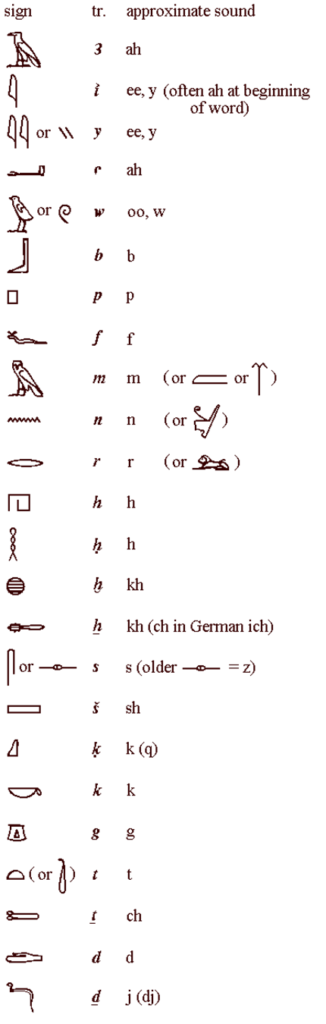
This is the Egyptian hieroglyphic alphabet, with transliterations which are used by Egyptologists, and the approximate sounds in English. These signs are essentially all consonants (even the ah’s and ee’s). The vowels were not written (see below), and are normally just said as “eh” (rarely “o”, in some words), nowadays.
Egyptian signs were of two types, phonetic signs, like these (along with many signs which were combinations of two or three sounds), and determinatives, signs which gave a clue to the meaning of the word. Most words were made up of phonetic signs, followed by one determinative. A few had two or three determinatives. Some very common words had no determinative. And, some other common words were written as just the determinative, with no phonetic signs. And there are common abbreviations, in which one or two signs stand for an entire word or phrase.
In this table, the alternative signs in parentheses were mainly used in later times.
Vowels: Above, I said that the vowels were not written. But, a few of these alphabetic signs are obviously vowels (pronounced “ah” or “ee”) in most modern languages. And signs with an “oo” or “w” sound were also used to represent a foreign (Greek, and other languages) “o” sound. These were not considered vowels, and sometimes had some guttural aspect. They are vowels in English, but not in Egyptian. So we write the a, i, o, u sounds, as these are Egyptian consonants.
If your name is David, then you could write it with five Egyptian signs (all consonants), “Dafid” (sorry there is no “v” sound). But if your name is Ben, I would write it “Bn,” in Egyptian. And I would not write other silent letters.
Actually the two “ah” signs in my list were not pronounced “ah.” The first one, the Egyptian vulture, was a guttural sound not found in English. It was followed by an unwritten vowel, often an “ah” sound. And so it often sounded very much like “ah,” even though it was a consonant. The second “ah,” the arm and hand, was a glottal stop, a short hesitation between vowel sounds, like in Cockney “bottle,” which sounds like “bah-uhl.” This sign too often sounded like “ah,” not because it was a vowel, but because it was followed by an unwritten vowel sound.
Other letters: Also, the lion which represented the “r” sound, was often used for the foreign “L” sound. The “q” sound is apparently slightly different from the “k” sound.
Gérard Anaclet Vincent Encausse (1865-1916) – pseudonym ‘Papus’ – the Spanish-born French physician, hypnotist, and populariser of occultism, who founded the modern Martinist Order. His family moved to Paris when he was 4 years old, and he was educated there. As a young man, Encausse spent a great deal of time at the Bibliothèque Nationale studying the Kabbalah, occult tarot, magic and alchemy, and the writings of Eliphas Lévi. He joined the French Theosophical Society shortly after it was founded by Madame Blavatsky in 1884–1885, but he resigned soon after joining because he disliked the Society’s emphasis on Eastern occultism.
Papus is primarily remembered as an author of books on magic, Qabalah (Kabbalah) and the Tarot, and as a prominent figure in the various occultist organizations and Parisian spiritualist and literary circles of the late 19th and early 20th centuries. Encausse’s pseudonym “Papus” was taken from Eliphas Lévi’s “Nuctemeron of Apollonius of Tyana” (supplement to Dogme et Rituel de la Haute Magie) and means “physician.”
The definition of Kabbalah varies according to the tradition and aims of those following it, from its religious origin as an integral part of Judaism, to its later Christian, New Age, and Occultist/western esoteric syncretic adaptations. Kabbalah is a set of esoteric teachings meant to explain the relationship between an unchanging, eternal, and mysterious Ein Sof (infinity) and the mortal and finite universe (God’s creation). It forms the foundations of mystical religious interpretation. Kabbalah seeks to define the nature of the universe and the human being, the nature and purpose of existence, and various other ontological questions. It also presents methods to aid understanding of the concepts and thereby attain spiritual realisation.
In 1888, Papus co-founded his own group, the Kabbalistic Order of the Rose-Croix. That same year, he and his friend Lucien Chamuel founded the Librarie du Merveilleux and its monthly revue L’Initiation, which remained in publication until 1914.
Encausse was also a member of the Hermetic Brotherhood of Light and the Hermetic Order of the Golden Dawn temple in Paris (joining in 1895), as well as Memphis-Misraim and probably other esoteric or para-masonic organizations, as well as being an author of several occult books. He was also a spiritual student of the French spiritualist healer, Anthelme Nizier Philippe, “Maître Philippe de Lyon”.
Despite his heavy involvement in occultism and occultist groups, Encausse also pursued more conventional academic studies at the University of Paris. He received his Doctor of Medicine degree in 1894, after which he opened a relatively successful clinic in the rue Rodin.
In 1891, Papus formed an organization commonly known as the Order of the Martinists, which was based on two extinct Masonic Rites: the Rite of Elus-Cohens or Elected Priests of Martinez Paschalis, or de Pasqually (c.1700-1774); and the Rectified Rite of Saint-Martin of Louis Claude de Saint-Martin (1743-1803). Papus claimed to have come into the possession of the original papers of de Pasqually and to have been given authority in the Rite of Saint-Martin by his friend Henri Viscount Delaage, who claimed that his maternal grandfather had been initiated into the order by Saint-Martin himself, and who had attempted to revive the order in 1887. The Martinist Order was to become a primary focus for Papus, and continues today as one of his most enduring legacies.
In 1893, Encausse was consecrated a bishop of l’Église Gnostique de France by Jules Doinel, who had founded this Church as an attempt to revive the Cathar religion in 1890. In 1895, Doinel abdicated as Primate of the French Gnostic Church, leaving control of the Church to a synod of three of his former bishops, one of whom was Encausse.
Encausse visited Russia three times, in 1901, 1905, and 1906, serving Tsar Nicholas II and Tsarina Alexandra both as physician and occult consultant. In October 1905, he allegedly conjured up the spirit of Alexander III, the Tsar Nicholas’s father, who prophesied that the Tsar would meet his downfall at the hands of revolutionaries. During their later correspondence, he warned them a number of times against the influence of Rasputin. Encausse’s followers allege that he informed the Tsar that he would be able to magically avert Alexander’s prophesy so long as Encausse was alive; Nicholas kept his hold on the throne of Russia until 141 days after Papus’s death.
Encausse opposed Masonry as being atheistic, in contrast to the Esoteric Christianity of the Gnostic Church, the Kabbalist Order of the Rose Cross and the Martinist Order. Despite this, he organized what was announced as an “International Masonic Conference” in Paris on June 24, 1908, and at this conference he received a patent from Theodor Reuss to establish a “Supreme Grand Council General of the Unified Rites of Antient and Primitive Masonry for the Grand Orient of France and its Dependencies at Paris.” When John Yarker died in 1913, Papus was elected as his successor to the office of Grand Hierophant (international head) of the Antient and Primitive Rites of Memphis and Mizraim.
When World War I broke out, Papus joined the French army medical corps. While working in a military hospital, he contracted tuberculosis and died in 1916, aged 51.
His works include:
Traité élementaire de science occulte (1888) Le tarot des bohémiens (1889) Traité méthodique de science occulte (1891) Le tarot divinatoire (1909) Traité méthodique de magie pratique (1932) Le science des nombres (1934) Elementary Treaty of Occult Science (1889) Considerations on the Phenomena of Spiritualism (1890) Methodical Treaty of Occult Sciences (1891) Absolute Key to Occult Science: The Tarot of the Bohemians (1892) The Science of the Magi and Its Theoretical and Practical Applications (1892) Elementary Treaty of Practical Magic (1893) Martines de Pasqually / His life – His Theurgic Practices – His Work His Disciples (1895) Occultism and Spiritualism (1902) Louis-Claude de Saint-Martin / His life – His Theurgic Path – His Works – His disciples (1902) The Kabbalah: Secret Tradition of the West (1903) Science of the Magi and Its Theoretical and Practical Applications (1905) Essay of Synthetic Physiology (1909) First Elements of Astrosophy (1910) First Elements of Human Morphology (1912)
Benjamin Franklin is famous for his list of 13 virtues, which he used as a personal code of conduct to help him live a moral and productive life. The virtues, as listed by Franklin in his autobiography, are:
Temperance: Eat not to excess; drink not to excess; sleep not too little; neither too much. Avoid all kinds of excess.
Silence: Speak not but what may benefit others or yourself; avoid trifling conversation.
Order: Let all your things have their places; let each part of your business have its time.
Resolution: Resolve to perform what you ought; perform without fail what you resolve.
Frugality: Make no expense but to do good to others or yourself; i.e., waste nothing.
Industry: Lose no time; be always employed in something useful; cut off all unnecessary actions.
Sincerity: Use no hidden or dishonest dealings, but be open, plain, and honest in all your transactions.
Justice: Wrong none by doing injuries, or omitting the benefits that are your duty.
Modesty: Avoid vanity; be humble; avoid arrogance.
Cleanliness: Keep both body and soul clean.
Transquility: Be calm, quiet, and peaceful; avoid anger, impatience, and passion.
Affability: Be friendly and kind to all; engage in cheerful conversation with every one.
Gratitude: Be thankful for all the favors you receive.
These virtues were a significant influence on Franklin’s personal development and helped shape his character, making him one of America’s most influential founding fathers.