 Alchemical symbols have fascinated scholars and mystics for centuries, serving as a secret visual language for those who sought to transform base metals into gold and discover the elixir of life. Hidden within these enigmatic markings lies a complex system of knowledge that extends far beyond mere chemical formulas. These cryptic representations once protected the sacred wisdom of transformation from uninitiated eyes, encoding spiritual and philosophical concepts that remain compelling even in our modern era.
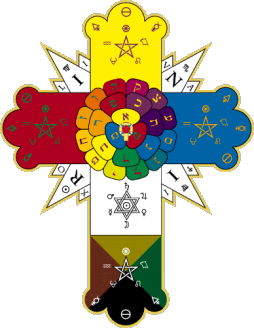
Throughout history, specific symbols have held particular significance in alchemical tradition, specifically the Hermetic Cross, which represents the perfect union of opposing forces. Similarly, the three primary substances—Salt, Sulfur, and Mercury—symbolize the body, soul, and spirit respectively, forming the foundation of alchemical philosophy. Beyond these basics, symbols like the Rose became central to Rosicrucian traditions, representing secrecy, rebirth, and the unfolding of spiritual consciousness.
Indeed, decoding these ancient symbols reveals a sophisticated understanding of the universe that blended science, spirituality, and psychology. From the Tria Prima to the seven planetary metals, each symbol contains layers of meaning waiting to be uncovered. Whether you’re new to esoteric traditions or a seasoned student of hermetic philosophy, this exploration will illuminate the profound symbolic language that alchemists used to encode their quest for physical and spiritual transformation.
The Tria Prima: Foundations of Alchemical Symbolism
The cornerstone of alchemical philosophy rests upon the tria prima, or three primes—a revolutionary concept introduced by the 16th-century Swiss alchemist Paracelsus. According to his teachings, all material substances in existence are composed of three essential principles: Sulfur, Mercury, and Salt [1]. This trinity creates the foundation for understanding both physical matter and spiritual transformation in alchemical practice.
Sulfur 🜍 as the Soul and Volatility
The symbol for Sulfur—a triangle atop a cross (🜍)—represents the active, masculine principle in alchemy [2]. Often called “the soul,” Sulfur embodies the principle of combustibility [1], associated with fire and transformation. This element symbolizes consciousness, the volitive nature that drives change, and the expansive force that enables dissolution [3].
Sulfur holds the qualities of heat and dryness, aligning with the element of fire and solar energy [3]. In practical demonstrations, alchemists like Paracelsus would illustrate Sulfur’s nature by burning wood—the resulting flame representing this volatile principle [3]. As the soul component of existence, Sulfur connects the higher spiritual realms with material reality, functioning as a fluid bridge between elevated and mundane states [3].
Mercury ☿ as the Spirit and Fluidity
Mercury, represented by the symbol ☿, embodies the spirit or mind—the omnipresent life force that mediates between opposing states [3]. Known as “quicksilver” for its liquid form at room temperature, Mercury physically demonstrates its philosophical attribute of transcending states of matter [4]. This unique characteristic led alchemists to view Mercury as transcending fundamental dualities: life/death, heaven/earth, liquid/solid [3].
Essentially, Mercury represents the principle of fusibility and volatility [1], characterized by cold and moist qualities—opposite to Sulfur’s hot and dry nature [3]. The symbol itself combines a crescent moon (receptivity), circle (infinity), and cross (matter), visually depicting Mercury’s role as the channel for infinite spirit entering material form [2]. Furthermore, Mercury functions as the passive feminine principle that receives and shapes the active force of Sulfur [3].
Salt 🜔 as the Body and Stability
Salt, symbolized by a circle bisected by a horizontal line (🜔), represents the physical body and material foundation of existence [3]. This principle embodies non-combustibility and non-volatility [1], serving as the stable, fixed element that grounds spiritual energies. The horizontal line within Salt’s symbol represents time—beginnings and endings within the context of eternity (the circle) [2].
Salt corresponds to the contractive force, condensation, and crystallization in nature [3]. Additionally, it represents the essence of all things [5], starting as coarse and impure but capable of refinement through alchemical processes [3]. This purification mirrors the alchemical journey itself—breaking down to build anew with greater purity [3].
The three primes function together through a process alchemists called Solve Et Coagula—dissolving and coagulating—whereby materials are separated, purified, and recombined [3]. This relationship creates a multidimensional correspondence system:
- Material aspects: flammable (Sulfur), volatile (Mercury), solid (Salt) [3]
- Elements: fire (Sulfur), air (Mercury), earth/water (Salt) [3]
- Human nature: soul/spirit (Sulfur), mind/spirit (Mercury), body (Salt) [3][3]
Through this triadic framework, alchemists developed a comprehensive system for understanding both physical transformations and spiritual development, establishing the foundation upon which all other alchemical symbols and processes would build.
The Four Classical Elements and Their Symbolic Geometry
Ancient alchemists adopted a visual language based on geometric forms to represent the four classical elements—Fire, Water, Air, and Earth. These fundamental elements, first canonized by Aristotle, formed the basis of alchemical understanding long before modern chemistry emerged. Their symbols, derived from the medieval magical Seal of Solomon, encode profound philosophical principles through simple triangular forms.
Fire 🜂: Upward Triangle and Transformation
The alchemical symbol for Fire (🜂) is represented by a simple upward-pointing triangle. This geometric form perfectly captures fire’s natural tendency to rise, reflecting its aspiring, transformative nature. Greek philosopher Heraclitus considered fire the most fundamental element, believing it gave rise to all others through a series of transformations he called the “turnings of fire” [6].
Fire embodies the qualities of heat and dryness according to Aristotelian philosophy. The upward triangle symbolizes not only physical flames but consequently represents powerful emotions—passion, love, anger, and hate [7]. In Plato’s cosmology, fire associates with the tetrahedron, the Platonic solid with the least volume and greatest surface area, mirroring fire’s sharp, stabbing heat [6].
In practical alchemy, fire relates to sulfur, representing the combustible principle. When Paracelsus burned wood, he demonstrated this connection—the flame represented sulfur’s work [8]. Moreover, the symbol’s masculine characteristics align with its active, transformative powers, making it a potent symbol for conversion in alchemical operations.
Water 🜄: Downward Triangle and Intuition
Water’s alchemical symbol (🜄) appears as an inverted triangle—a perfect inversion of fire’s symbol, visually representing their opposing natures [9]. This downward-pointing triangle embodies water’s natural tendency to sink and find its level. The Greek philosopher Thales believed water was the first substance created in the world [10].
Aristotle classified water as cold and wet, whereas Hippocrates connected it to the bodily humor phlegm [10]. Throughout alchemical tradition, water has been associated with intuition, emotion, and receptivity [11]. The symbol was often depicted in blue, reinforcing its connection to depths, both physical and psychological [12].
Furthermore, water corresponds to mercury in alchemical associations, both sharing feminine qualities [10]. This relationship highlights water’s flowing, adaptive nature—a substance that takes the shape of its container while maintaining its essential properties.
Air 🜁: Breath, Thought, and Expansion
Air’s symbol (🜁) features an upward-pointing triangle bisected by a horizontal line, representing breath, thought, and expansion [1]. The ancient Greeks used two distinct words for air: aer for the lower atmosphere and aether for the bright upper atmosphere [3]. Plato associated air with the octahedron, placing it between fire and water in his elemental hierarchy [3].
According to Aristotle, air possesses qualities of both heat and wetness, occupying an intermediary position between fire and water among the elemental spheres [3]. Anaximenes, among the early Greek Pre-Socratic philosophers, named air as the arche—the fundamental principle [3].
In alchemical practice, air mediates between fire’s volatile energies and water’s emotional nature, creating balance within the alchemical process [1]. Additionally, air connects to the alchemical process of “separation,” whereby truth is distinguished from illusion, promoting deeper self-awareness and personal growth [1].
Earth 🜃: Grounding and Materiality
Earth’s symbol (🜃) appears as a downward-pointing triangle crossed by a horizontal line—the inverse of air’s symbol [13]. This geometric form represents stability, solidity, and material existence. Aristotle classified earth as cold and dry, connecting it to the bodily humor black bile [10].
The alchemical symbol’s connection to green and brown colors reinforces its association with the physical world of nature and growth [12]. Earth represents grounding, physical sensations, and material reality in alchemical operations [10].
Throughout history, alchemists incorporated these four elements into laboratory designs, often arranging them in quadrants to create harmonious and balanced environments for alchemical transformations [14]. Their geometric symbolism continues to inform contemporary esoteric practices, encoding ancient wisdom about the fundamental nature of reality.
Seven Planetary Metals and Their Celestial Associations
From antiquity through the mid-eighteenth century, only seven metals were known and recognized—each “ruled” or “dominated” by one of the seven classical planets visible to the naked eye. This sevenfold correspondence between metals and celestial bodies formed a cornerstone of alchemical practice, creating a unified system that connected earthly substances to cosmic influences.
Gold ☉ and the Sun: Perfection and Heart
Gold, the most noble metal, bears the symbol of a perfect circle with a central point (☉), mirroring the sun’s radiance. As the supreme light in alchemy, gold represents physical, mental, and spiritual perfection. Just as the Sun occupies the center of the classical cosmos, gold correlates with the heart—the central organ of vitality in the human body. Alchemists viewed this incorruptible metal as the ultimate goal of the “Great Work,” symbolizing enlightenment and divine truth.
Silver ☽ and the Moon: Reflection and Mind
Silver carries the crescent moon symbol (☽), embodying clarity, purity, and reflective qualities. The metal’s lustrous appearance perfectly mirrors the moon’s ability to reflect sunlight. Throughout alchemical tradition, silver connects with the brain and mind, governing intuition and the subconscious. The term “lunatic” derives from luna (moon), reflecting ancient beliefs that the moon could influence mental states by manipulating fluids in the brain.
Iron ♂ and Mars: Strength and Gallbladder
Iron bears the symbol of Mars (♂)—a circle with an arrow emerging, representing the god’s shield and spear. This hard, durable metal naturally associated with war and conflict corresponds to the gallbladder in medical alchemy. Named after the Roman god of war, iron’s strength made it ideal for weapons, cementing its martial associations.
Copper ♀ and Venus: Harmony and Kidneys
Copper carries Venus’s symbol (♀)—a circle with a small cross beneath, representing the goddess’s mirror. Found abundantly near Cyprus (thought to be Venus’s birthplace), copper’s warm, reddish hue and malleability connected it with feminine beauty and harmony. In the body, it governs the kidneys.
Mercury ☿ and Mercury: Duality and Lungs
Quicksilver, uniquely liquid at room temperature, bears the symbol (☿) resembling the caduceus—the staff carried by Mercury, messenger of the gods. This metal transcends solid and liquid states, symbolizing duality and transformation. Mercury governs the lungs, facilitating the exchange between inner and outer worlds.
Tin ♃ and Jupiter: Wisdom and Liver
Tin’s symbol (♃) represents Jupiter, king of the Roman gods. Sometimes called the “breath of life,” tin embodies the concept that “the whole is stronger than the sum of its parts.” In the body, it corresponds to the liver—an organ of growth and regeneration reflecting Jupiter’s expansive qualities.
Lead ♄ and Saturn: Weight and Spleen
Lead, the heaviest common metal, bears Saturn’s symbol (♄)—resembling a scythe or stylized “h” with a cross. Considered the oldest metal and the prima materia (first matter), lead represents the starting point of alchemical transformation. Its correspondence with the spleen reflects Saturn’s association with restriction and melancholy.
Alchemical Compounds and Processes in Symbolic Practice
Beyond the foundational elements and planetary metals, alchemists developed complex symbolic representations for compounds and processes essential to their practice. These symbols encoded both practical laboratory procedures and spiritual transformations within a unified visual language.
Vitriol 🜖 and the Path of Inner Purification
Vitriol, represented by a circle with a horizontal line extending beyond it (🜖), was considered the most important liquid in alchemy, serving as a catalyst for all subsequent reactions [15]. This symbol entered the Unicode block as U+1F716 [16]. The alchemical motto for vitriol—Visita Interiora Terrae Rectificando Invenies Occultum Lapidem—translates to “Visit the interior of the earth and purifying you will find the hidden stone” [15]. Chemically, vitriol referred to various sulfates that functioned as powerful solvents [2].
Aqua Regia 🜆 and the Power to Dissolve Gold
Aqua regia (🜆), also called “royal water,” consists of nitric and hydrochloric acids mixed in a 1:3 molar ratio [17]. This powerful solvent earned its regal name because it could dissolve gold—something neither acid could accomplish independently [17]. First appearing in alchemical literature around 1300 CE [18], aqua regia works through a complex process: nitric acid oxidizes gold into ions while hydrochloric acid provides chloride ions that convert these gold ions into soluble chloroauric acid [17].
Calcination ♈︎ and the Fire of Transformation
Calcination, symbolized by the astrological sign for Aries (♈︎), represents the first stage in the alchemical magnum opus [2]. This fire operation literally means “reduced to bone by burning” [19]. Psychologically, calcination symbolizes the burning away of the ego through life experiences, creating space for spiritual growth [19]. Associated symbols include phoenixes, funeral pyres, and scenes from hell [19].
Sublimation ♎︎ and the Rise of Spirit
Sublimation, marked by Libra’s symbol (♎︎), involves solid material giving off vapors that condense directly into pure powder [19]. Alchemists considered this a superior form of distillation—a direct path to the Philosopher’s Stone [19]. The process symbolizes the elevation of consciousness from material to spiritual planes.
Fermentation ♑︎ and the Birth of New Matter
Fermentation, represented by Capricorn (♑︎), introduces new life into previously transformed matter [20]. Beginning with putrefaction (decomposition), this stage creates fertile ground for rebirth [20]. Symbolized by the color green, grapevines, and rebirth imagery, fermentation represents spiritual enlightenment through the death of the old self [19].
Modern Encoding and Preservation of Alchemical Symbols
Unlike the enduring philosophical concepts behind alchemical symbols, their written representations nearly vanished from practical use after the 18th century. By 1813, Berzelius had introduced modern chemical notation, effectively eliminating what remained of alchemical symbology [21]. Despite this scientific obsolescence, these ancient symbols found new life in the digital age.
Unicode Block U+1F700–U+1F77F Overview
Until recently, digital representation of alchemical symbols remained fragmented. Eventually, in 2010, Unicode version 6.0 introduced a dedicated block for alchemical symbols, spanning code points U+1F700 to U+1F77F [22]. This block contains 124 distinct symbols [22], representing substances, processes, and equipment essential to alchemical practice. The Indiana University Digital Library Program’s “Chymistry of Isaac Newton Project” played a pivotal role in developing this proposal [23].
Symbol Rendering Challenges in Digital Media
In fact, despite formal standardization, rendering these symbols remains problematic. Few fonts support more than a handful of characters in this block as of 2021 [22]. For researchers studying historical texts, this creates significant obstacles. Notably, the freely available Symbola 14.0 font offers comprehensive support [22], while others have developed specialized fonts like Newton, LudyTenger, and Alchemy Textbook [4].
Use of Alchemical Symbols in Contemporary Esotericism
Surprisingly, although scientific utility has waned, these symbols maintain relevance in scholarly literature, creative works, New Age disciplines, and the gaming industry [23]. Their visual power transcends their original context, offering modern practitioners connection to ancient wisdom traditions.
Conclusion
Ancient alchemical symbols represent far more than mere chemical formulas or laboratory instructions. Throughout this exploration of hermetic visual language, we have uncovered layers of meaning embedded within these cryptic markings. The Tria Prima—Sulfur, Mercury, and Salt—stands as the philosophical cornerstone of alchemical thought, embodying the soul, spirit, and body respectively. These principles established a framework for understanding both material transformations and spiritual development.
Additionally, the four classical elements—Fire, Water, Air, and Earth—expressed through elegant geometric triangles, provided alchemists with a comprehensive system for categorizing the natural world. Their visual representations elegantly captured essential qualities: Fire’s upward aspiration, Water’s downward flow, Air’s mediating presence, and Earth’s solid foundation.
Perhaps most fascinating was the correspondence between the seven planetary metals and celestial bodies. Gold associated with the Sun, Silver with the Moon, Iron with Mars, Copper with Venus, Mercury with Mercury, Tin with Jupiter, and Lead with Saturn. This seven-fold system connected terrestrial substances to cosmic influences, creating a unified worldview where microcosm reflected macrocosm.
Alchemical processes like Vitriol, Aqua Regia, Calcination, Sublimation, and Fermentation further enriched this symbolic language. Each operation encoded both practical laboratory procedures and metaphorical transformations of consciousness.
Though scientific advancement eventually replaced alchemical notation with modern chemical symbols, these ancient markings survived through esoteric traditions. The recent inclusion of alchemical symbols in Unicode demonstrates their enduring cultural significance despite challenges in digital rendering.
Ultimately, the Hermetic Cross and its accompanying symbolic language remind us that ancient alchemists sought more than material transmutation—they pursued a comprehensive understanding of nature, consciousness, and spiritual evolution. Their visual wisdom continues to fascinate and inspire, bridging centuries of human inquiry into the fundamental nature of reality. These enigmatic symbols still beckon modern seekers to decode their mysteries, offering glimpses into a worldview where science, spirituality, and art formed an integrated whole rather than separate domains of knowledge.
References
[1] – https://www.sanctuaryeverlasting.com/meaning-of-the-element-of-air/
[2] – https://en.wikipedia.org/wiki/Alchemical_symbol
[3] – https://en.wikipedia.org/wiki/Air_(classical_element)
[4] – https://scholarworks.iu.edu/dspace/bitstreams/94d647a1-beed-4e5d-93f4-a44a07c5caee/download
[5] – https://symbolikon.com/downloads/salt-alchemy/
[6] – https://en.wikipedia.org/wiki/Fire_(classical_element)
[7] – https://religion.fandom.com/wiki/Fire_(classical_element)
[8] – https://www.cabinet.ox.ac.uk/alchemy-four-elements-and-tria-prima
[9] – https://en.wiktionary.org/wiki/🜄
[10] – https://blog.prepscholar.com/alchemy-symbols
[11] – https://www.occult.live/index.php/Water_(element)
[12] – https://www.thoughtco.com/alchemy-symbols-and-meanings-4065063
[13] – https://www.oksymbols.com/2022/07/alchemical-symbol-copy-paste-alchemical-symbols.html
[14] – https://12thhousejewelry.com/blogs/12th-house-journal/the-fascinating-connection-between-alchemy-and-sacred-geometry?srsltid=AfmBOooJpXAgSheh4FQJXD5wAeHy605W8i_PP20bztOPesUrskPg9CJt
[15] – https://www.reddit.com/r/TrueDetective/comments/3crn34/season_2_alchemical_meaning_of_catalyst_and_the/
[16] – https://www.hotsymbol.com/symbol/alchemical-symbol-for-vitriol
[17] – https://www.chemicals.co.uk/blog/what-is-aqua-regia?srsltid=AfmBOoriRVHiGp1BaHGmW2OPX7yQ-OHoqQmujPcY0wEXU6semGdYY1jW
[18] – https://www.labyrinthdesigners.org/alchemy-ancient-chemistry/aqua-regia-and-fulminating-gold-according-to-lemery/
[19] – https://www.hogwartsishere.com/courses/ALCH-401/lesson/611/
[20] – https://alchemical.fandom.com/wiki/Fermentation
[21] – https://hsm.stackexchange.com/questions/2178/modern-usage-of-alchemical-symbols
[22] – https://en.wikipedia.org/wiki/Alchemical_Symbols_(Unicode_block)
[23] – https://webapp1.dlib.indiana.edu/newton/fonts/Alchemy Unicode Proposal—March 31 2009.pdf